
The Daily Signal — Friday April 17
Sustained system pressure is exposing gaps in leadership, control, and execution.

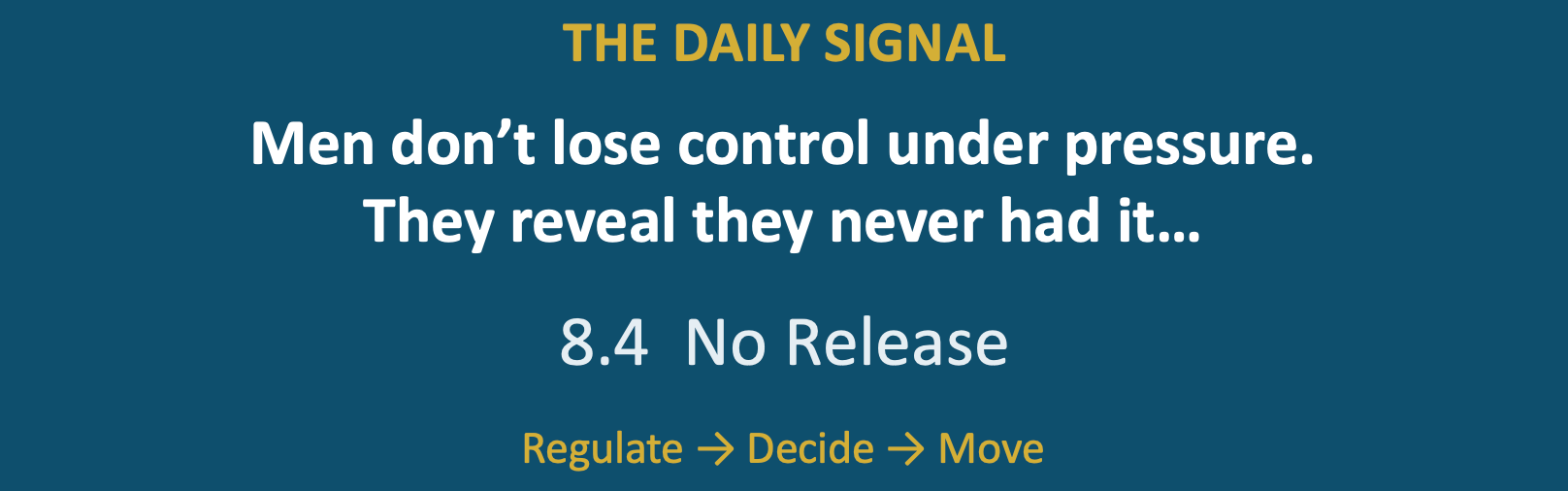
PRESSURE
Signal Within the Signal
“In preparing for battle I have always found that plans are useless, but planning is indispensable.” — Dwight D. Eisenhower
Pressure doesn’t break systems.
It reveals them.
What holds.
What bends.
What was never built to carry the load.
This is where leadership becomes visible—
not in calm conditions, but under strain.
What The Daily Signal Reviews:
The Daily Signal decodes global volatility, energy constraints, AI acceleration, operational pressure, and leadership response—turning noise into system-level clarity for leaders operating in real environments.
Executive Summary
Pressure remains elevated across systems.
Energy costs are holding high.
AI infrastructure demand is increasing load on physical systems.
Operational friction is rising—but not always visible.
The issue is no longer awareness.
It is response.
Signal Score: 8.4 ↑ (Disruption — sustained pressure without release)
Trend: Sustained High Pressure
What This Means for Leaders
Pressure is not the problem.
Unregulated pressure is.
Watch for:
Decisions sitting too long
Teams waiting instead of acting
Escalations delayed under the appearance of alignment
Under pressure, systems don’t improve.
They default.
Pressure is not the problem.
Unregulated pressure is.
Watch for:
Decisions sitting too long
Teams waiting instead of acting
Escalations delayed under the appearance of alignment
Under pressure, systems don’t improve.
They default.
What This Signal Reveals
This is where Norman’s Law applies:
When external pressure exceeds internal regulation, disruption occurs.
The system cannot regulate what it cannot see - and under pressure, Signal Compression increases.
The gap is widening.
External pressure:
AI infrastructure demand
Energy constraints
Geopolitical instability
Internal response:
Slower escalation
Hesitation in ownership
Fragmented decision flow
The system isn’t breaking.
It’s carrying more than it can regulate.
Energy Signal
WTI Crude: ~$85/barrel
Brent Crude: ~$88/barrel
U.S. Gasoline: ~$3.95/gallon
Diesel: ~$4.20/gallon
Natural Gas: Elevated and volatile
Energy is not spiking.
It is holding pressure.
And sustained pressure is what tests systems.
Costs at this level compress:
Margins
Decision speed
Execution capacity
AI demand is no longer theoretical.
It is now physically loading the grid.
Under pressure, energy becomes:
A constraint on scale
A driver of operational friction
A system-level force
Technology & AI Signal
AI is shifting from capability to constraint.
The limiting factors are now:
Power
Data center capacity
Physical infrastructure
Talent at the infrastructure layer
The engineers who can build, operate, and integrate these systems are becoming scarcer than the power itself.
Every industrial race eventually bottlenecks on skilled labor—not just capital.
This is no longer a software race.
It is an industrial one.
Competitive advantage will accrue to those who control physical capacity—not those who ship fastest.
Operational Pressure
Four patterns are emerging:
Decision latency under pressure
Escalation hesitation
Ownership diffusion
Signal Compression
Signal Compression is the mechanism underneath the others.
As information moves upward, it gets filtered—not out of deception, but out of conflict avoidance and uncertainty.
The result:
Problems appear smaller than they are
Risks are softened
Decisions are made on incomplete reality
The system cannot regulate what it cannot see.
What this costs:
Speed
Quality of decisions
Morale of the people who see the gap but can’t get it resolved
Execution is not failing loudly.
It is being quietly constrained.
Leadership Signal (MOS) Behavior Under Pressure
What breaks:
Leaders absorb pressure instead of directing it.
What that looks like:
Holding decisions too long
Avoiding escalation
Waiting for certainty
What’s required:
Direct it. Don’t absorb it.
What that looks like in practice:
Name the constraint out loud
Assign ownership immediately
Set the clock for resolution
Pressure must move.
George S. Patton
“A good plan violently executed now is better than a perfect plan executed next week.”
MOS of the Day (MOSei)
(Management Operating System external and inner systems)
Escalation Integrity
Pressure reveals where escalation fails.
Ask:
Where is something known… but not moving?
Then:
Who knows it—and what are they waiting for?
The first question finds the constraint.
The second finds the owner.
Together, they create movement.
Inner Operating System (IOS) - Yoga / Breath
We include yoga because performance today is not just external execution—it’s internal regulation.
Control is not force.
It is steadiness under load.
Today’s practice: Ujjayi Breath — 5 minutes
Slow inhale, controlled exhale, slight throat constriction
Build control internally—
before applying it externally.
“In volatile systems, your nervous system is the control center.”
Signal Score & 7-Day Rolling
Signal Score: 8.4 ↑
7-Day Rolling Signal:
Sunday: 7.9 ↑
Monday: 8.1 ↑
Tuesday: 8.2 ↑
Wednesday: 8.3 ↑
Thursday: 8.3 →
Friday: 8.4 ↑
Trend: Sustained High Pressure
Signal Score Legend — (1–10 Scale)
0–2.9: Stable
3.0–4.9: Watch
5.0–6.9: Pressure
7.0–8.4: Disruption
8.5–10: Crisis
If You Do One Thing Today
Before your first meeting today:
Name one thing that is known but not moving.
Decide what happens to it by end of day.
Final Signal
Noise: “We need more time.”
Signal: “We already know enough to act.”
Pressure doesn’t create character.
It reveals it.
And in systems—
what gets revealed… gets amplified.
Sources
Global & Geopolitical: Reuters, Bloomberg, Financial Times
Markets & Energy: EIA, IEA, AAA
Technology & AI: MIT Sloan, industry data
Leadership & MOS: Field-tested systems
Yoga / IOS: Certified teaching and practice
Subscribe / Share CTA
If this sharpened your signal and clarified your next move:
Subscribe. Share. Or forward to one operator who needs it.
Because under pressure,
clarity is control.
Love the Patton quote!