
The Daily Signal - Friday May 1
The Strait didn’t ambush anyone.

The Strait didn’t ambush anyone.
It announced itself - and most leaders are still managing the announcement instead of making the decision.
What the diplomatic coverage is not telling you. What the system is already doing. What you need to decide before Monday.
FRIDAY SIGNAL SCORE
9 / 10 - Maximum system pressure. Real constraint. Real cost. Decision window closing.
OPENING SIGNAL
This is not a briefing on the Strait of Hormuz.
This is a briefing on the decision you haven’t made yet and what it’s already costing you.
THE DECODE
WHAT MOST LEADERS ARE WATCHING
• Diplomatic positioning and ceasefire proposals
• Military posture and UN resolutions
• Timeline to reopening
• Energy price as headline
WHAT THE SYSTEM IS ACTUALLY DOING
• Shipping rerouted (+10–14 days per voyage)
• Insurance repricing risk in real time
• Energy buyers locking $105–$130/bbl
• Decision windows closing
The gap: Leaders are watching the narrative. The system is moving capital.
SIGNAL POSITION
The Strait of Hormuz crisis is now the largest energy supply disruption in recorded history:
• 20% of the world’s oil and 30% of its LNG transit this channel
• Traffic collapsed 95% from pre-crisis baseline
• Brent crude: $105–$130/bbl
• Peace talks stalled again Friday
The coverage is accurate. That’s exactly why it doesn’t give you the decision.
It’s which leaders have restructured their operations around the constraint that already exists and which are still waiting for a resolution that changes nothing about their Q3 cost structure.
WHAT REALLY HAPPENED
Sixty days ago the first signals hit:
• Not a closure a slowdown, a route change, an insurance premium spike
• Easy to classify as temporary. Easy to defer.
Each week the pressure increased:
• Tanker traffic dropped
• Spot rates spiked
• Cape of Good Hope reroutes: +10–14 days, +30–40% fuel cost per voyage
• Costs entered the system nobody had modeled.
Somewhere around day fourteen, the situation crossed from developing story to locked-in constraint. Nothing dramatic happened on that day. That is the point.
The system didn’t wait for confirmation. It moved when probability was enough. The leaders who recognized that crossing acted in week two.
The leaders who didn’t are now paying $105–$130/bbl managing consequences, not decisions. That is Norman Decision Time running out at global economic scale.
SIGNAL WITHIN THE SIGNAL
The failure mode here is not panic. It is language.
The leader still calling this “a situation to monitor” has already lost the decision. Because monitor means:
• No ownership
• No time constraint
• No decision clock
• And the system runs on all three
Signal Compression is running exactly as it always does: the ceasefire narrative makes a structural operational decision feel contingent on a diplomatic outcome. It is not:
The diplomatic outcome determines timing.
It does not determine your cost structure.
The Norman Gap opened at day seven.
The distance between “we know this is a constraint” and “we have made a structural decision around it.” For most operations, that gap is still open. Every week it stays open, the market is deciding for you.
SYSTEM PRESSURE STACK
ENERGY SIGNAL
• Brent: $105–$130/bbl
• LNG spot: multi-year highs
• Un-modeled cost entering every operational cycle
This is not a price problem. It is a decision architecture problem.
TECHNOLOGY & AI SIGNAL
• Google’s AI Hyper-computer was announced this week
• Microsoft: $10B Japan AI infrastructure commitment
• Intel–Google multiyear co-development locked
Every major AI infrastructure bet runs on energy now priced into a constrained system. The buildout is accelerating into the disruption.
OPERATIONAL PRESSURE
• Cape reroutes: +10–14 days per voyage
• +30–40% fuel cost per rerouted voyage
• Supply chains modeled at one price environment now operating in a structurally different one
Without updated decision architecture, the gap between model and reality widens every week.
LEADERSHIP SIGNAL — BEHAVIOR UNDER PRESSURE
What broke
• Leaders framed this as a situation to monitor, not a constraint to decide around
• The diplomatic narrative gave that framing permission
Monitoring a $120/bbl environment instead of acting inside it is not caution. It’s abdication with a professional vocabulary.
What should have happened
At day seven, the correct question was not “will the strait reopen?” It was:
• What is our structural exposure if it doesn’t?
• What can we do at $80/bbl that we cannot do at $120?
• That question was answerable then. Most leadership teams never asked it.
See it → Own it → Move
• See the constraint - not the narrative around it
• Own the decision your operation requires regardless of the diplomatic outcome
• Move before the market closes the option
The leaders with structural advantage from this crisis moved in week two. The ones still no longer deciding are absorbing the cost of delay.”
MOS OF THE DAY (MOSei))
This week, define the three thresholds that automatically trigger a decision in your operation:
• Energy cost threshold - at what price per barrel does your sourcing decision change?
• Lead time threshold - at what delay does your supplier switch activate?
• Supplier dependency threshold - at what concentration does diversification become mandatory?
Write them down. Assign an owner to each. The deliberation happens now, when pressure isn’t in the room.
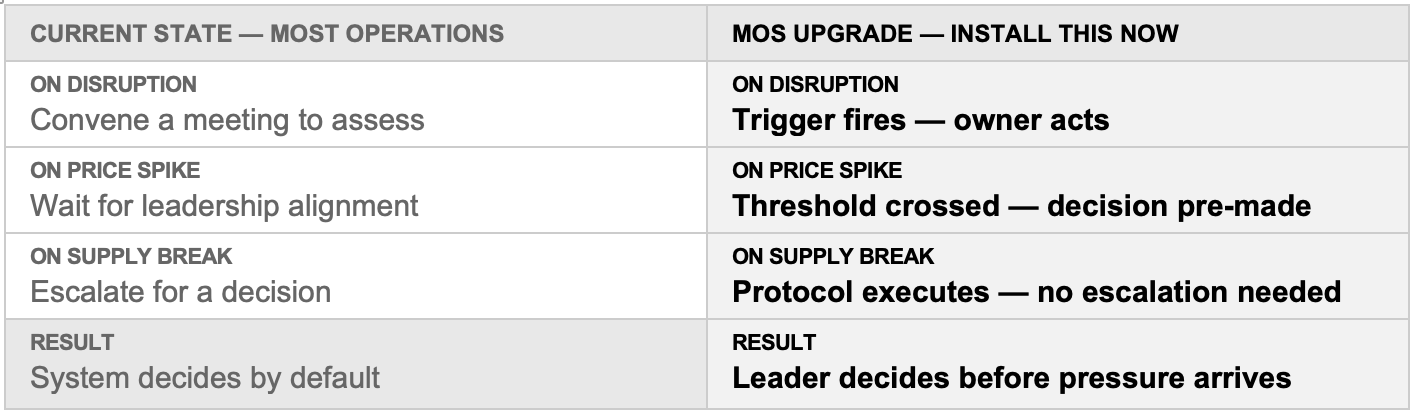
Most operating systems are built to respond to pressure. The MOS upgrade is to decide before it arrives - so when the Strait signals, you already know what to do.
INNER OPERATING SYSTEM (IOS) - REGULATE
When pressure rises, the instinct is to gather more information before committing. Under Signal Compression, that instinct is the exact mechanism keeping the gap open.
The thirty-second internal audit:
• Am I waiting for clarity - or waiting for the system to decide for me?
Those two things feel identical from the inside. They have completely different costs.
The leaders who survived this kind of pressure before trained one thing: the pause before the instinct runs. Not to delay the decision. To own it.
IF YOU DO ONE THING TODAY
1. Name the exposure. Energy cost. Lead time. Supplier dependency. Numbers only.
2. Name the decision. Separate it from the diplomatic outcome.
3. Assign it. One owner. End of day.
SIGNAL SCORE & 7-DAY ROLLING
Today’s Score: 9.0 / 10 - Norman’s Law at global economic scale. Norman Decision Time running out for every leader still treating this as a diplomatic event.
7-Day Rolling:
Mon — 7.6 ↑
Tue — 7.9 ↑
Wed — 8.4 ↑ Thu — 8.5 ↑ Fri — 9.0 ↑
Sat — X.X
Sun — X.X

FINAL SIGNAL
The event isn’t the signal.
The timing of system movement is.
And the system has already moved.
SOURCES
Global & Geopolitical: Reuters, Bloomberg, Financial Times
Markets & Energy: EIA, IEA, AAA
Technology & AI: MIT Sloan, industry data
Leadership & MOS: Field-tested systems
Yoga / IOS: Certified teaching and practice
CTA
Subscribe to The Daily Signal.
Send this to one leader who is under pressure and doesn’t have clear signal.
Clarity before others move is the advantage.
"And if you want the full training system - REGULATE is on Amazon."
WHAT THE DAILY SIGNAL REVIEWS
The Daily Signal decodes global volatility, energy constraints, AI acceleration, operational pressure, and leadership response—turning noise into system-level clarity for leaders operating in real environments.