
The Daily Signal - Sunday April 26
Ninety Seconds

That is the distance between a $180K penalty and a $47K solution
OPENING SIGNAL
The signal was never the problem. The ninety seconds after it arrived were.
SIGNAL POSITION
THE PATTERN THAT SURFACED THIS WEEK
All week, leaders missed one sequence build — decision speed, ownership discipline, signal integrity, systems under pressure, leadership behavior under stress. Each day was one piece. Today is the architecture. The sequence doesn’t just happen in boardrooms and supply chains. It happened at 6:47 AM, in ninety seconds, with $2.1M on the line and at 6:47 AM, no one thought they were about to lose $180,000.
WHAT REALLY HAPPENED
WHY IT CAN’T WAIT
Because the next alert is already scheduled. You don’t know when it arrives. You don’t control the supplier, the market, or the pressure. You only control what happens inside the ninety seconds after the signal lands. If that’s untrained — the sequence runs. Every time.
WHAT SHIFTS IF LEADERS SEE THIS CLEARLY
They stop building external systems to solve internal failures. They start training the pause — the thirty-second regulation that interrupts the chain before it completes. That shift is the difference between a $47K cost and a $180K penalty.
SIGNAL WITHIN THE SIGNAL
WHAT ACTUALLY HAPPENED
6:47 AM.
A supplier alert hits. Critical component delayed. $2.1M shipment at risk. Four-hour customer window. The signal was clear. The system worked exactly as designed — the alert fired, the information was accurate, the timeline was visible.
But in the next ninety seconds, something else activated.
• Messages stacked
• Pressure rose
• Attention narrowed
Before any external action — the internal system was already deciding the outcome
OPERATIONAL PRESSURE
WHERE IT BREAKS — THE FULL CHAIN
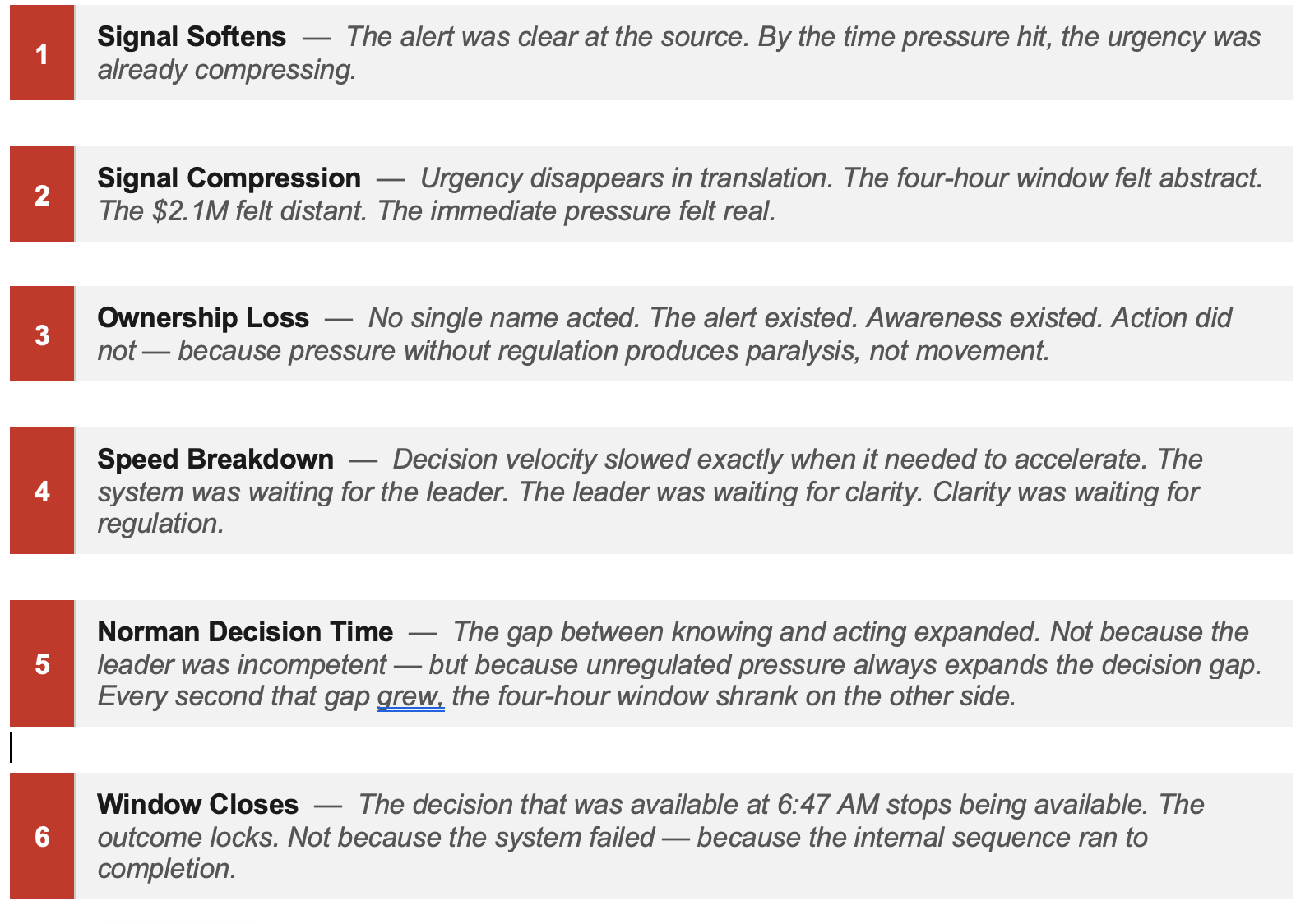
This is the sequence that ran in those ninety seconds. You’ve seen each piece this week. Here is the complete architecture:
LEADERSHIP SIGNAL — BEHAVIOR UNDER PRESSURE
THE MOMENT THAT DETERMINES EVERYTHING
It was not the alert. It was not the supplier. It was not the $2.1M.
It was the time between ‘we know’ and ‘we act.’ That is Norman Decision Time.
And in this case — thirty seconds changed it.
Pause. Regulate. Decide: “What is the fastest path to delivery?”
• Problem separated from pressure
• Ownership assigned to one name
• Decision made inside the window
Regulate → Decide → Move
WHAT THE PATTERN IS
Systems don’t fail from a single breakdown. They fail when speed slows, ownership blurs, signals distort, and decisions come too late — all at once. The sequence is not random. It is predictable. And it always starts the same way: pressure arrives faster than regulation can respond.
WHERE IT REPEATS
• Every supply chain disruption where the alert fired but action came late
• Every leadership team that knew the risk but waited for consensus
• Every operator who felt the pressure and froze instead of acted
WHERE LEADERS MISS IT
They look for the failure in the system — the alert, the protocol, the escalation path. The failure is never there. It is in the ninety seconds after the signal arrives, before any external action begins. That is where the sequence either runs or gets interrupted.
Norman’s Law: If pressure exceeds internal regulation — disruption occurs.
THE LAW IN PLAY
At 6:47 AM, pressure arrived with the alert. It rose in ninety seconds. In an unregulated leader, it exceeds the internal threshold — and Norman’s Law executes. The chain runs. Signal compresses. Ownership blurs. Decision gap expands. Window closes. The law does not care about intention, experience, or intelligence. It executes on the gap between pressure and regulation. Every time.
WHAT IT PREDICTS
Any leader who has not trained their internal regulation will lose decision time under pressure. Not occasionally. Predictably. The only variable is the size of the consequence when the window closes.
WHAT IT DEMANDS
Train the pause before the pressure arrives. The cold water plunge is the model — the first time, the body panics. Breathing goes shallow. Thinking narrows. Reaction takes over. The tenth time, you have learned to regulate the shock before it controls you. Same pressure. Trained response. Decision stays inside the
MOS OF THE DAY (MOSEI)
The operating system correction is not a new protocol. It is not another dashboard. It is this: build the regulation before the pressure arrives. Every leader needs a trained internal response to the first signal — not the crisis, but the moment before the crisis becomes one. The MOS fix is structural: schedule the practice, not the response. When the alert fires, the regulation is already loaded.
INNER OPERATING SYSTEM (IOS) - REGULATE
The pause is not weakness. It is the most powerful move available in the ninety seconds after a signal arrives. Every leader who has stood in cold water and learned to breathe through the shock knows this: the regulation is the decision. Train it. Own it. It is the only thing that keeps the window open.
“The full training system for this is in Regulate - the practice that turns the pause from instinct into discipline.”
IF YOU DO ONE THING TODAY
When pressure arrives this week - and it will - how many seconds pass before you regulate?
Don’t answer it here. Carry it into every meeting, every alert, every decision point Monday through Friday. The answer is your current Norman Decision Time. The goal is to shrink it.
Find the moment this week when pressure arrives before you’re ready, and practice the thirty-second pause before you act. Write one sentence that separates the problem from the pressure. Then assign one name. That sequence, repeated under real conditions, is how Norman’s Law gets trained out of your operating system.
SIGNAL SCORE & 7-DAY ROLLING
Today’s Score: 9 / 10 - System pressure: confirmed. Norman's Law in effect. Real case, real numbers, real interruption. Score reflects depth of consequence and clarity of the interruption mechanism.
Weekly Average Score:
The sequence built across five lenses. Decision speed, ownership, signal integrity, systems, leadership behavior. Sunday confirmed: the failure point is never the system. It is the ninety seconds after the signal arrives.
Week Average: 8.2 / 10

FINAL SIGNAL
The system didn’t save the shipment. Thirty seconds of trained regulation did — and that is a skill, not a circumstance.
Sources
Global & Geopolitical: Reuters, Bloomberg, Financial Times
Markets & Energy: EIA, IEA, AAA
Technology & AI: MIT Sloan, industry data
Leadership & MOS: Field-tested systems
Yoga / IOS: Certified teaching and practice
CTA
Subscribe to The Daily Signal.
Send this to one leader who is under pressure and doesn’t have clear signal.
Clarity is the advantage.
And if you want the full training system behind the thirty-second pause - Regulate is on Amazon.
WHAT THE DAILY SIGNAL REVIEWS
The Daily Signal decodes global volatility, energy constraints, AI acceleration, operational pressure, and leadership response—turning noise into system-level clarity for leaders operating in real environments.