
THE DAILY SIGNAL — SUNDAY EDITION April 19
Sunday is different. This is where we step back from the noise and examine the system underneath it.

Most systems don’t break at the point of impact.
They break after absorbing pressure for too long.
Signal Within the Signal
Nothing broke this week.
That’s the signal.
Systems didn’t fail.
They absorbed more pressure than they released.
That’s where disruption begins.
Executive Summary
Pressure increased across systems
No meaningful release occurred
Internal regulation did not keep pace
Norman’s Law is in motion
The Signal — What I’m Seeing
This is my HRV.
I track it every day on my Apple Watch. Not for curiosity—for signal.
I traveled all week.
Airports. Hotels. Constant movement.
I came home Friday and looked at the data:
Average: 41 ms
Range: ~20 ms to ~60 ms
You don’t need interpretation.
You can see it without explanation.
The system is not steady.
Lower readings around 20 ms → load
Higher readings near 60 ms → partial recovery
But it doesn’t hold.
It rises—then drops again.
Nothing is broken.
But everything is under pressure.
Recovery hasn’t caught up to the load.
This is not a wellness observation.
It’s a system reading.
And it’s the same pattern you see in:
manufacturing systems running too hot
governments absorbing a war it didn’t budget for
organizations reporting performance without adjusting direction
Same structure.
Pressure increased.
Regulation did not.
Norman’s Law
When external pressure exceeds internal regulation, disruption occurs.
This isn’t theory.
It’s observable.
In data.
In organizations.
In history.
I named it because I kept seeing it - in data, in rooms, in history - and needed something to call it.
Once you see it, you can’t stop seeing it.
The Pattern — This Week in One Frame
Across systems, the same sequence repeated:
Energy costs remained elevated → operational drag increased
AI demand accelerated → infrastructure strain built
Geopolitical tension held → uncertainty compounded
Organizations reported performance → but didn’t change direction
Nothing collapsed.
Nothing stabilized.
That’s not coincidence.
That’s a system carrying more than it was design to regulate.
Signal Compression
Here is the mechanism that hides the gap until it’s too late
Signal Compression:
The loss of truth, clarity and urgency as real problems move up through layers of an organization.
Historical Context
The Roman Senate received filtered reports for decades before the empire’s territories became indefensible.
McNamara’s body counts replaced ground truth in Vietnam.
The FDA has received summarized trial data that softened findings.
By the time it reaches the decision level, it has been translated, softened, and reframed.
Reality is strongest at the point of contact.
On the floor:
The constraint is known
The barrier has a name
The problem is specific
As it moves up:
It gets summarized
Then softened
Then reframed
By the time it reaches leadership:
The problem still exists
But the signal is weaker
What it looks like
On the floor:
“The bottleneck is down 30% due to changeover delays and missing material.”
One level up:
“We’re seeing some variability in output.”
Executive level:
“Performance is slightly below plan.”
The problem didn’t change.
The signal did.
Why it matters
When signal weakens:
Decisions slow
Resources don’t move
Systems drift
The organization believes it has time.
It doesn’t.
Connection to Norman’s Law
Pressure is real at the floor
Regulation is delayed at the top
Response comes too late
Leaders are not failing because they are wrong.
They are failing because the signal is diluted.
Norman’s Law — Applied Across Systems
Geopolitics - Russia
Russia is not operating on speed.
It is operating on endurance.
As Fiona Hill has emphasized:
absorb pressure
extend timelines
outlast opposition
It doesn’t need to win quickly.
It needs others to lose the ability to sustain the effort.
The Soviets absorbed it in Afghanistan and bled their own system dry in the process.
This is Norman’s Law at the state level:
Pressure is maintained.
Regulation struggles to keep pace.
Instability becomes the operating condition
Manufacturing — Operational Reality
The same structure appears on every floor I’ve worked on.
The Bottleneck Illusion
High OEE across most lines
Bottleneck overloaded
Throughput flat
System appears efficient
Output does not move
Tier Meetings Without Movement
Issues raised
KPIs reviewed
No ownership shift
No resource movement
Work is visible
Not acted on
Demand Spike Without Adjustment
Demand increases
System unchanged
Then:
Expedites rise
Quality drops
Lead times extend
In every case:
Pressure increased
Regulation did not
The gap widened before failure appeared
The Norman Gap
The gap is always measurable before it becomes visible.
You see it in:
decision speed
throughput vs demand
recovery patterns
Stages of failure
Small gap - stability
Growing gap - friction
Large gap - breakdown
Extreme gap - collapse
Most systems live in friction longer than they realize.
Because friction still looks like progress, meetings still happen, metrics still get reported.
The system looks like it’s working.
Until it doesn’t.
The Gap Can Close
Churchill inherited a government running on pure signal compression in May 1940.
It was signal distortion.
Winston Churchill inherited:
sanitized reporting
softened assessments
disconnected leadership
The gap between reality and regulation at the decision level was extreme.
His first move wasn’t strategy.
It was a speech, it was restoration.
direct communication
unfiltered intelligence
proximity to reality
He didn’t reduce pressure.
He improved regulation.
And the system could carry the load again.
Within six weeks the regulation had changed. The system could carry the load again.
Why I Wrote Regulate
I didn’t write it as a wellness idea.
But as a systems response.
I kept seeing the same pattern:
leaders overwhelmed
systems overloaded
decisions delayed
Everyone was trying to fix the environment.
Almost no one was strengthening the system processing it.
The gap isn’t only geopolitical.
It isn’t only organizational.
The same gap exists at the human level.
When the nervous system is overloaded:
judgment slows
clarity drops
decisions drift
The leader becomes the bottleneck.
Not through incompetence -
through unmanaged load.
Inner Operating System (IOS)
If Norman’s Law is true:
Regulation is structural. Not optional.
Every decision flows through one system: your nervous system.
Reset Protocol (Pre-Decision Calibration)
Slow the inhale
Extend the exhale
Bring attention inward
Hold long enough to feel the noise reduce.
This is not relaxation.
This is recalibration.
If You Understand This, You See Everything Differently
Pressure is always increasing
Regulation determines outcome
The gap predicts failure
The signal appears in the data before it shows up in the event.
Most people wait for the event.
Final Signal
The systems that survive are not the strongest.
They are the most regulated.
Pressure is rising everywhere.
The question is no longer:
Can you handle it?
But:
Can you regulate it?
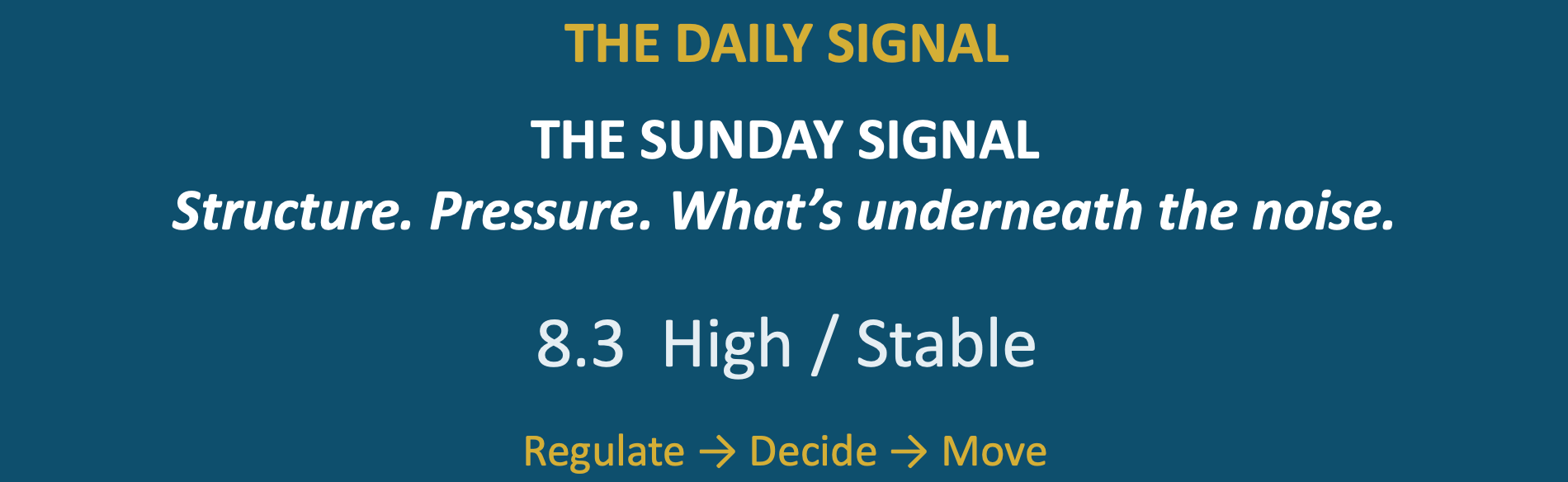
Signal Score
8.3 → Sustained Pressure, No Release
7-Day Rolling Signal
Monday → 8.1 ↑
Tuesday → 8.2 ↑
Wednesday → 8.3 ↑
Thursday → 8.3 →
Friday → 8.3 →
Saturday → 8.3 →
Sunday → 8.3 →
Trend: Pressure remains elevated with no meaningful release.
Sources
Global & Geopolitical: Reuters, Bloomberg, Financial Times
Markets & Energy: EIA, IEA, AAA
Technology & AI: MIT Sloan, industry data
Leadership & MOS: Field-tested systems
Yoga / IOS: Certified teaching and practice
Subscribe
If this helped you see the system more clearly — share it with one person operating under pressure.
Most people react to events. Very few see the structure underneath them.
Subscribe to The Daily Signal.